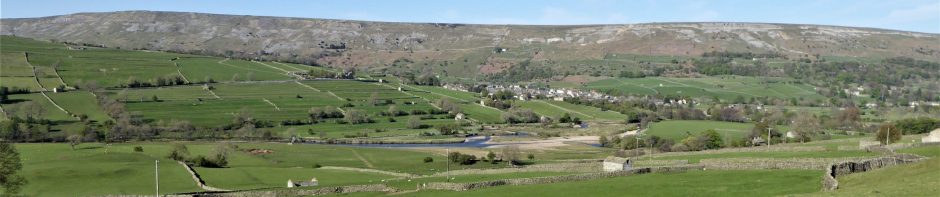

The word ‘shieling’
Records of the word shieling survive from as early as the 13th century, when the spellings were typically skaling, scaling, and schaling. It was a word attributed to a place of summer pasture for livestock, usually related to the practice of transhumance, in which lowland cattle were driven to graze high moorland or mountain pastures while the lowlands were used to grow hay for winter fodder.
The word was originally used for the type of hut erected on the summer pasture to provide seasonal temporary accommodation for the herders. Etymologists say the word is derived from the west-Scandinavian root skáli ‘a temporary hut or shed’ and therefore originated in the Norwegian Viking settlement of the northern counties. In Cumbrian dialect, the word survives close to its original form in scale or skell ‘a hut’. It also survives in this form in some place-names. In Swaledale, Skelgate, now Skelgate Lane, which runs in between fields from the west side of Reeth village and up to the open moor on Calver Hill, is almost certainly named as the gata ‘way’ to the skáli ‘summer hut or pasture.’
The evolution of the word from skáli to skaling, then shieling, and its expansion to mean the pasture as well as the hut might have been a joining with Old Norse eng ‘wet meadow or pasture’ to give a combined meaning of ‘hut pasture.’ A possible example of this is below the Reeth-Healaugh road, just east of Healaugh village, where a row of six large, riverside fields, amounting to 25 acres, are called the Scale Ings. A nearby seventh field was known in the 19th century as Scale House. This land seems to have been a kind of summer pasture quite different from the usual high moorland grazing area, although still high in the dale to a lowland farmer. Translations into modern English can be found in Swaledale, at Summer Lodge Pasture, above High Whitaside, and at Summer House Hill, near Tan Hill Inn.
Shieling sites in the northern Yorkshire Dales
A comprehensive account of the history of shielings and of research into known sites in Britain can be found online in the Historic England collection, Introduction to Heritage Assets. Among many insights, this document explains other root-words related to shielings and gives illustrated examples of moorland and riverside sites. It can be read here: Shielings (historicengland.org.uk).
It also explains that the practice of transhumance and the use of seasonal shieling huts seems to have died out in the 16th century. Perhaps this was when remote areas like the Yorkshire Dales became more intensely settled by permanently resident hill-farmers, who gained exclusive rights of pasture on the moorlands adjacent to their own farmsteads and settlements.
There is an article on shielings in the dales here: Shielings and summer pastures – Yorkshire Dales National Park : Yorkshire Dales National Park.
Landscape archaeologist Andrew Fleming believed he had identified remains of the typically small, rectangular shieling hut structures on Reeth Low Moor, just east of Calver Hill, and on Harkerside Moor (see his book Swaledale: Valley of the Wild River, Edinburgh, 1998, p. 77a). The Harkerside example was possibly the small rectangular building remains to be seen alongside the linear dyke at Harker Mires.
Another important source of information is Dennis Coggins, ‘Shielings and Farmsteads: Early Rectangular Buildings in Upper Teesdale,’ in Durham Archaeological Journal 8, 1992, 77-83.
SWAAG president Tim Laurie has noted several potential shieling hut sites during his extensive explorations of the northern Yorkshire Dales and recorded them as ancillary features in his entries in the SWAAG database, as follows:
– PDF for number group 51-100, see record no. 97.
– PDF for number group 602-651, see record no. 636.
– PDF for number group 652-701, see record no. 660.
– PDF for number group 702-751, see record no. 741.
– PDF for number group 752-801, see record nos. 753, 755, 774, 796, 797.
– PDF for number group 802-851, see record no. 832.
– PDF for number group 852-918, see record nos. 879, 897, 910.
– PDF for number group 919-970, see record nos. 962, 963.
Above article by Will Swales