A message from SWAAG treasurer, Alan Mills – I regret to have to inform you that Peter Denison-Edson passed away peacefully on Monday with his son, Will, by his side. Peter was a good friend to many of us. He was our first chairman, the driving force in the initial years, leading our first successful funding bid. Without him there would not be a SWAAG. He will be sadly missed by so many.
Back-filling of the trench and the test pit done, tent down, all the kit returned to store in Cotherstone.
Phew!
Once again a big thank you to everyone who participated, to our archaeologist, Tony Liddell, and to the Allison family for allowing us to dig on their land.
Maybe we will return next year. Meanwhile, I will reflect on what I think we have learnt and let you have my thoughts later next week.
So nothing on tomorrow, Sunday; have a peaceful day.
Well, we have made it to the end of the exploration, leaving the backfilling, re-turfing, dismantling the tent and returning all the kit to store in Cotherstone for the weekend. I think it has been a success. Twenty-two members and two students contributed. It was pleasing to see such commitment and enthusiasm despite the sometimes inclement weather. It shows that there is a future for SWAAG although we still need more help in running the group.
As far as archaeology is concerned, we achieved the objective of determining the nature of the ‘surface’ identified by the geophys, although whether it really is a surface is a moot point; maybe it is man-made, maybe it is geological. Thanks to Andrea & Rich in particular.
The main trench is similarly enigmatic; the surveys by Durham Uni and ourselves strongly suggest an Iron Age defended settlement. I still think that the site is a defended settlement of some period, maybe Iron Age, maybe even Romano-British, perhaps associated with the Hagg site in some way, but we haven’t found any evidence for occupation at all. The main finds are some nice flints (see the rather poor photo) but these don’t necessarily mean habitation here. Tony thinks the test pit soil, containing flakes of charcoal, might provide a clue so we will have a bag-full subjected to environmental analysis.
So like many digs, we now have more questions than answers. Hopefully, many will be resolved if we are able to dig here again next year.
Thanks to those who turned out today, much appreciated.
Sadly the weather forecast was correct and we had persistent rain from the off until around 2pm, We decided not to proceed with any digging today as not only would it trash the trench but it would be very slippery and unsafe.
We did have a lively discussion about what Tony’s 3D model of the trench told us (available at: https://skfb.ly/pKRNR ). Theories ranged from purely geological to a robbed out barrow; whatever we have, it doesn’t seem to be an Iron Age site as the only significant dateable finds are some nicely worked flints, possibly Late Bronze Age.
Thanks very much to Ele for the cakes and Gary for the biscuits; much appreciated.
Thanks also to those who came out today despite the rain in the hope we might dig. We look forward to seeing many of you tomorrow for the final digging day, Friday 12th June, 9:15am for a 9:30am start. Alan
Our best supported day so far, with 19 volunteers attending, on what also turned out to be the best day of the week so far, fortunately bearing only a passing resemblance to the weather forecast. We received permission first thing from the National Park’s Historic Environment Team to extend the trench to the East, so thanks to Sarah there, increasing the size of the excavated area by 50% to 27m2. This has given us a much better understanding of what is going on. It is easy to see features and patterns which don’t exist but it does seem that we are beginning to see the wall(s?) of one or more structures, possibly the elusive roundhouse which we are seeking. Towards the end of day Tony, our Site Archaeologist, took a large number of photos to enable him to use photogrammetry to both record and better understand the site. It will be interesting to see the results tomorrow.
Meanwhile work in the test pit continued. It seems clear that this has achieved the objective of determining the nature of the ‘surface’; rather than being at around 40cm as suggested by the geophysical surveys, it is a roughly cobbled surface at around 25cm, initially identified yesterday. The geophys suggests that at one time the surface covered a large area of the mound; indeed, some cobbling is evident in the main trench as can be seen on Marks’ overhead drone shot, below, taken towards the end of today.
Thanks very much to those who came out today and enjoyed the decent weather.
We look forward to seeing many of you tomorrow, Thursday 11th June, 9:15am for a 9:30pm start, when we again hope for a much better day than forecast.
Sixteen of us braved the conditions to continue the dig in frequent, often heavy, squally showers. The photo illustrates this, with the diggers in trench 1 wearing waterproofs often with hoods up. Nonetheless, we made good progress there and also opened up the test pit to explore the surface suggested by the ground penetrating radar at a depth of around 40cm; so far the work in the test pit indicates a roughly cobbled surface at around 25cm.
Trench 1 continues to be enigmatic. We have uncovered a significant number of large stones which might have been a stone wall for a roundhouse; with a bit of imagination it is possible to identify wall, broadly in the area suggested by the geophys but on the other hand there would seem to be too much tumble spread too widely. To help address this we will seek the approval of the National Park’s Historic Environment Team to extend the trench along the line of the potential wall.
On a more positive note, and perhaps rather surprisingly, Trench 1 has yielded a significant number of worked flint and chert flakes. Surprising, because these would appear to be late Bronze Age not the Iron Age which we are expecting. The work continues!
Thanks very much to those who came out today and remained in good spirits despite the weather.
We look forward to seeing many of you tomorrow, Wednesday 10th June, 9:15am for a 9:30pm start.
Fourteen of us plus Tony Liddell, our supervising archaeologist, spent an enjoyable day working on the main trench. The weather forecast for the day was poor but in fact we had good spells of warm sunshine, so much so, that despite using factor 50 I seem to have sunburn (or maybe windburn?).
We made excellent progress, taking much of the trench down by 15-20cm through the topsoil (context 1) and into a lighter, sandier, gravelly context 2 in places. A number of finds were recorded including two pieces of what might be daub, flint, clinker, charcoal and a fragment of pot but no conclusive dating evidence.
The attached photo shows the trench at the end of the day with a large amount of stone exposed. Is this from a stone wall of the sub-circular feature identified by geophysics, possibly a roundhouse? We should learn more as the dig progresses – weather permitting.
Thanks very much to those who came out today.
We look forward to seeing many of you tomorrow, Tuesday 9th June, 9:15am for a 9:30pm start.
Twelve intrepid diggers began the dig on a cold, damp and blustery day. We made tremendous progress, possibly because it was not a day to stand around talking but rather get the job over and done with and be off home!
With the help of Mark Rutter’s GPS ‘gizmo’ the trench and the test pit were set out, with cm accuracy we are told, while most of us were busy erecting the tent. Everything went very well so we began de-turfing after a tea break. The original plan was to de-turf around 3 metres at each end of the 9-metre trench but things went so well due to the sterling efforts of all, that we completed the de-turfing of both the trench and the test pit shortly after 2pm.
The trench was laid out to go over what geophys suggests is the wall of the sub-circular feature ( a roundhouse?) and lo and behold de-turfing exposed what might be that wall; see photo. Tempting as it was to begin exploring this, it will have to wait until Monday when Tony Liddell is on site.
Therefore, work tomorrow (Sunday) is CANCELLED. Today’s diggers can have a welcome rest.
Thanks very much to those who came out today.
We look forward to seeing most of you on Monday, 9:15am for a 9:30pm start.
Enjoy the rest of the weekend.
Alan
ps we had a slight panic when we realised we had no trowels. We had mistakenly left them in store but Anne popped up to Doe Park, found them behind some other ‘stuff’ and will bring them on Monday.
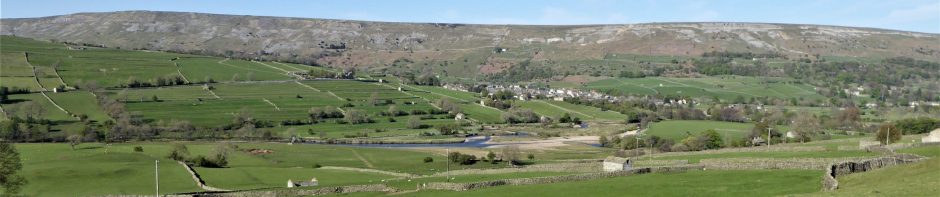
Header photograph shows a view across the River Swale to Reeth village, with medieval lynchets to the left and Fremington Edge forming the far horizon.
Receive our news - To receive alerts to your inbox every time any news is posted on our Home Page, simply enter your email address in the box below and click the Submit button. You won't be inundated and we won't share your email address with anyone.
You can also follow our social media posts. Just click on the icons below: