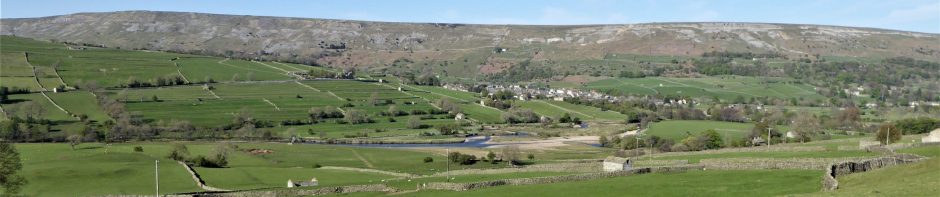

Tim Laurie’s accounts of the impressive array of ancient archaeological remains on Reeth High and Low Moors have been published in three articles and in a series of fieldwork reports spread over 26 years of his research.
The first article, published in 1985, described extensive archaeological features on several moors in and around Swaledale, including his findings on Calver Hill, otherwise known as Reeth Low Moor. It can be read here:
Early land division and settlement in Swaledale and on the eastern approaches to the Stainmore Pass over the north Pennines, in Upland Settlement in Britain: the Second Millenium BC and After, eds. Don Spratt and Colin Burgess, BAR British Series 143 (1985).
Reeth Low Moor, otherwise called Calverside, was the subject of 10 years’ fieldwork as part of the Swaledale Ancient Land Boundaries project, conducted jointly by Tim Laurie and Andrew Fleming, then of Sheffield University, between 1984 and 1993. All 10 annual reports can be seen here: Coaxial Field Systems Project.
The second article, the final report of the Swaledale Ancient Land Boundaries (SWALB) project, was published on the SWAAG website in 2010. It included a study of the ancient coaxial field systems on Reeth Low Moor and can be read here: Timothy C Laurie, Norman W Mahaffy, and Robert White, Coaxial Field Systems in Swaledale: a reassessment (SWAAG, 2010). An abridged version was published in Prehistory in the Yorkshire Dales, ed. R D Martlew (PLACE/Yorkshire Dales Landscape Research Trust, 2011).
The third article was published in 2011 in the form of an armchair guide to the Reeth Moors. In this unique account, representing a lifetime’s work, Tim explained that most of the time, most of the remains are invisible to the walker because they are covered by heather. His unrivalled knowledge of the key sites was accumulated over 40 years by himself and other field archaeologists, who seized timely opportunities to investigate individual sites when they were temporarily exposed by controlled heather-burning over small areas.
The article reveals some previously unreported sites and provides all the known evidence of man’s historic settlement and impact upon the Reeth Moors, from the hunter-gatherer Mesolithic period (Middle Stone Age) of up to 12,000 years ago, through the Neolithic period, the Bronze Age, Iron Age, Romano-British period, and up to the era of post-medieval mining settlements. You can read Tim’s 22-page article by clicking the link here: Archaeological landscapes of Reeth Moor, in Memoirs, British Mining No. 92, ed., Richard Smith (The Northern Mine Research Society, 2011).
SWAAG database
There are also relevant accounts in the SWAAG database. See the following PDFs:
– Records numbered 1-50 – scroll to nos. 41 (Enclosures) and 48 (Archaeological Random Finds).
– Records numbered 450-499 – scroll to no. 483 (Photographic), image 14, showing Reeth Low Moor above West Raw Croft.
– Records numbered 752-801 – scroll to no. 773 (Coaxial Field Systems), images 19 and 24.
– Records numbered 919-979 – scroll to nos. 957 (Burial Mounds and Cairns), 958 (Lithic Finds), 959 (Settlements), 960 (Enclosures) and 964 (Settlements).