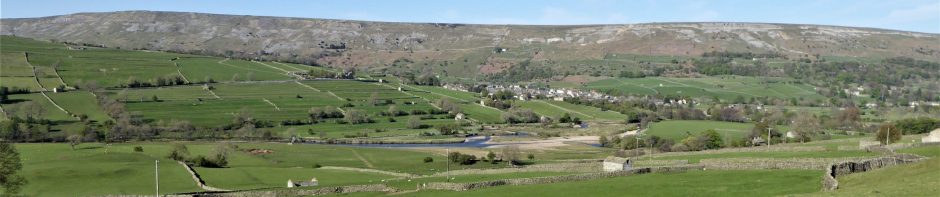

In 1990, when Tim Laurie and Andrew Fleming were at the end of their seventh season studying the ancient coaxial field systems in the moors of upper Swaledale, they started to investigate signs of field systems and settlements within the present-day enclosed farmland, below the moors, especially in Harkerside.
This work continued in the 1991 and 1992 seasons, culminating in the 10th and final report of the project at the end of the 1993 season. Thanks to a grant from the British Council, the fieldwork that year had been partly undertaken by a team from the Institute of Human Geography at the University of Stockholm. This team surveyed almost all the zone between Grinton village and the western Grinton-Fremington Dyke.
They identified substantial remains of a pattern of small fields and numerous associated settlement sites; mostly oval house-platforms cut into the hillside. It was deduced that a medieval hamlet, recorded in early documents as Hercay, once ran along the spring line from the current farm of Harkerside Place to a field named Dykehouse Close. Summaries and survey plans can be seen on the page Coaxial Field Systems, Reports 7, 8, 9, and 10.
The survey of the settlement site at Dykehouse Close, alongside the western dyke, led Andrew Fleming to re-interpret the parallel Grinton-Fremington Dykes as post-Roman in date and to suggest that they were constructed to defend a British upper-dale kingdom against aggression from Angles to the east. This idea formed a core hypothesis in Fleming’s book Swaledale: Valley of the Wild River (Edinburgh, 1998), and subsequently led, over many years, to some fascinating and challenging debates among senior academics.
A summary of the progress of the main discussion of the issues raised by Andrew Fleming is in the history section of this website, here: Early Medieval Period c,400 to 1066.
Access to the several reports and records concerning the Grinton-Fremington Dykes and a recent development of the research, concerning medieval records of the field systems and settlement remains around the dykes below the moor can be found here: Grinton-Fremington Dykes.
SWAAG database
More about the Harkerside ancient settlements below the moor can be found in the SWAAG database here:
– Settlements 1 category PDF – Dykehouse Close, record nos. 119 and 595, west of the western dyke, record no. 594, and at Whitbecks, record no. 600.
– Photographic category PDF – Dykehouse Close and Whitbecks, snow photos and two ancient settlement survey plans, record no. 710, images 1-4.
– Burnt Mounds 1 category PDF – Harkerside enclosures, record nos. 12, 14.
– Earthworks category PDF – How Hill, Whitbecks, record no. 354. Tree Sites 3 category PDF – Low Lane wych elm laid hedgerow, record no. 659.