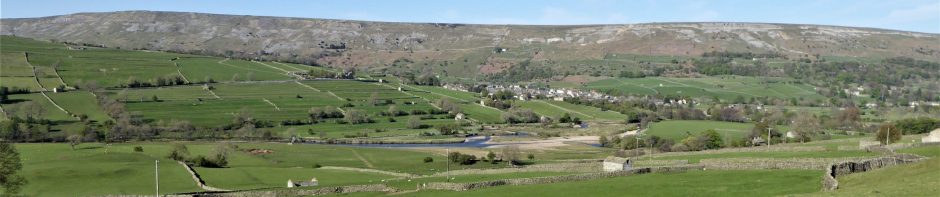


During landscape archaeological survey work in the 1980’s, Tim Laurie came to recognise the importance of relict and ancient trees within the dales landscape and noted the previously unrecognised presence of indicator species from the post-glacial era, particularly within Swaledale.
During his work with Andrew Fleming, then of Sheffield University, on the Swaledale Ancient Land Boundaries (SWALB) project, the pair invited Oliver Rackham (1939-2015), of the University of Cambridge, the author of the seminal works Ancient Woodland (1980) and The History of the Countryside (1986), and the country’s foremost authority on ancient woodlands, to examine and advise upon some of the most intriguing tree sites in the dale. Brief accounts of this early work can be found in the SWALB interim reports here: Coaxial Field Systems, see Reports 5 and 6 for the years 1988 and 1989.
In 2004, Tim’s paper, Springs, Woods and Transhumance: Reconstructing a Pennine Landscape during Later Prehistory, was published in the peer-reviewed academic journal Landscapes. In an abstract, he explained that from the evidence of pollen reports and from the fragments of semi-natural woodland that survived on the dale sides and at the head of tributary streams, it was possible to reconstruct the fully developed woodland environments of the upper dales as they were soon after 4000 BC, i.e., after the establishment of all tree species but prior to extensive human interference. The full paper can be read here:
In February 2011, a year or so after the foundation of SWAAG, Tim began a major research project with the aim of underpinning his notional reconstruction of the prehistoric woodland environment, specifically in Swaledale. He sought to record more-completely the distribution and composition of surviving woodland fragments in the dale, generally those of native trees that survive on limestone scars, in remote waterfall ravines, or at other locations inaccessible to grazing livestock, as well as relict hedgerows and individual trees of significant age. Tim wrote that with a few exceptions, the survey was confined to localities at or above the moorland edge. Woods wholly within improved pastures were excluded.
Tim acknowledged from the beginning that he was not a trained botanist, and therefore could not achieve the aims of the survey without the assistance and active participation of Linda Robinson, one of the recorders for the north-west Yorkshire ‘vice-county’ of the Botanical Society of Britain & Ireland (BSBI). Tim wrote: “Linda Robinson has accompanied me on much of the fieldwork and all the credit for the botanical records must be assigned to her.”
Tim recognised that in Swaledale, as elsewhere, very different woodland vegetation had developed in response to the soils derived from the abruptly changing rock strata – calcareous limestones succeeded by base poor sandstones and chert strata, and from the glacial drift covered lower dale slopes. Therefore, he determined that the tree-site findings should be grouped according to four different geographical areas of Swaledale, as shown on the map below, labelled 1 to 4. For comparison, Tim also recorded selected woodlands within catchments of the River Ure, and of the Rivers Tees and Greta. These are labelled as areas 5 and 6 on the map. All the areas are further defined in the caption to the map.

The six areas of the Swaledale Woodland Project: 1, Upper Swaledale within the civil parish of Muker; 2, Mid-Swaledale south-bank tributaries, from Muker parish boundary eastwards to the river’s confluences with Arkle Beck and Grinton Gill; 3, Lower Swaledale, from the River Swale confluence with Arkle Beck downstream to Richmond; 4, Mid-Swaledale north-bank tributaries comprising the catchments, from west to east, of Gunnerside Beck, Barney Beck, Arkle Beck, Marske Beck, and Clapgate Beck; 5, selected woodland sites within the catchment of the River Ure; 6, selected sites within the catchment of the Rivers Tees/Greta (Stainmore).
It was soon apparent from Tim’s findings that key species in the catchment of the River Swale west of Richmond included aspen, juniper, wych elm, and yew. He found that the relict woodlands of the River Swale catchment deserved to be recognised as relatively isolated populations.
His preliminary conclusions from the early stages of the Swaledale Woodland Project were expressed in an article ‘Relict woodland on the cliffs and within the waterfall ravines of Swaledale – an introduction,’ which Tim presented in September 2012 to the Trees Beyond the Wood conference of the South Yorkshire Biodiversity Research Group of the Biodiversity and Landscape History Research Institute, held at Sheffield Hallam University. The full article can be read here:
After the Sheffield conference, Tim’s recordings of tree sites in and around Swaledale continued for another five years, during all that time entering new records in the SWAAG database, until the last record was entered in March 2017. In total there are 211 tree records on the database, 173 categorised as Tree Sites and 38 records of individual trees within tree-sites, categorised as Trees and Shrubs. All together they form the Swaledale Woodland Project, which can be examined only on this website. No final report has been produced.
Browse through the Tree Site and Trees & Shrubs records to see a spectacular collection of stunning photographs of some of the most beautiful, wild and remote gills and waterfalls to be found anywhere in Britain. For a quick way to the waterfall photos, go to the Photo Studies menu on this website.

In the five tree-category database PDFs now available at the links below, the records have not been grouped according to the six geographical areas delineated by Tim’s map (above). However, the records have been identified by those areas in the following table:
Area 1, Upper Swaledale, Muker parish (73 records)
| Tree Sites 1 PDF | 36 records: 235, 267-69, 278, 283-84, 295, 307-08, 316, 323-24, 326-28, 331-36, 339-41, 343-45, 347-52, 355, 357. |
| Tree Sites 2 PDF | 26 records: 359-60, 363-64,370-76, 378-85, 388, 404-06, 457, 463-64. |
| Tree Sites 3 PDF | 5 records: 504, 608-09, 624, 707. |
| Tree Sites 4 PDF | 2 records: 833, 936. |
| Trees & Shrubs PDF | 4 records: 296, 317, 630, 679. |
Area 2, Mid-Swaledale, River Swale south-bank tributaries (19 records)
| Tree Sites 1 PDF | 1 record: 292. |
| Tree Sites 2 PDF | 6 records: 389, 448-49, 451, 471, 480. |
| Tree Sites 3 PDF | 6 records: 497, 508, 554, 631, 639, 659. |
| Tree Sites 4 PDF | 1 record: 931. |
| Trees & Shrubs PDF | 5 records: 293-94, 470, 479, 553. |
Area 3, Lower Swaledale (27 records)
| Tree Sites 1 PDF | 5 records: 167-68, 173, 224, 289. |
| Tree Sites 2 PDF | 6 records: 395, 402, 407-09, 484. |
| Tree Sites 3 PDF | 6 records: 503, 516, 539, 576, 642, 650. |
| Tree Sites 4 PDF | 2 records: 778, 786. |
| Trees & Shrubs PDF | 8 records: 157, 170, 197, 290, 506, 584, 626, 969. |
Area 4, Mid-Swaledale, River Swale north-bank tributaries (51 records)
| Tree Sites 1 PDF | 6 records: 171, 181, 195, 199, 277, 287. |
| Tree Sites 2 PDF | 11 records: 387, 411-12, 420-24, 428, 492-93. |
| Tree Sites 3 PDF | 18 records: 494-96, 537-38, 548-49, 644, 651, 653-54, 687, 693, 697-98, 700, 702, 708. |
| Tree Sites 4 PDF | 4 records: 709, 729-30, 886. |
| Trees & Shrubs PDF | 12 records: 123, 288, 491, 613, 627, 652, 655-56, 658, 949, 968, 982. |
Area 5, River Ure catchment (15 records)
| Tree Sites 1 PDF | 1 record: 309 |
| Tree Sites 2 PDF | 1 record: 456. |
| Tree Sites 3 PDF | 2 records: 500, 629. |
| Tree Sites 4 PDF | 8 records: 720, 722-23, 725, 727-28, 811-12. |
| Trees & Shrubs PDF | 3 records: 310-11, 726. |
Area 6, Rivers Tees/Greta catchment (26 records)
| Tree Sites 1 PDF | 1 record: 179. |
| Tree Sites 2 PDF | 0 records. |
| Tree Sites 3 PDF | 13 records: 507, 518-23, 581, 605, 610, 667, 668, 689. |
| Tree Sites 4 PDF | 6 records: 825-26, 843-44, 938, 961. |
| Trees & Shrubs PDF | 6 records: 298-300, 551, 582, 975. |
There are also photos of tree sites and the photo of Tim Laurie above in the Photographic category PDF, link below:
Photographic – scroll to records nos. 482, 590, 766, 785, 788, 939, 970, 990.