Planning a walk in November is not without its risks but fortunately the weather remained dry for our last walk of 2024. Twelve people joined leader Jane Harrison to look at the remains of the Scots Dyke around Richmond.
Remaining sections of this linear earthwork are scheduled but much of it has been ploughed out or is heavily eroded. It is an east facing bank and ditch with a counterscarp bank in places. The dyke can be traced from just south of the river Swale, where we started, to Stanwick St John about 14 kilometres away, where its relationship to the Brigantes fort has been much debated. Henry MacLauchlan (1792-1882), a surveyor, geologist and archaeologist, concluded that it extended further north to the river Tees. Some antiquarians suggested that it ran right up to the Scottish borders. Over time the height of the dyke has decreased and the ditch has infilled but at Whitefields, where our walk concluded, it is still over 4.5 metres high and 30 metres wide.
Very little excavation of the dyke has taken place. In 2004 an excavation prior to house building on St Nicholas Drive, Richmond, showed that there was a deliberate gap in the earthwork at that point. When the A66 was widened in 2006-7, excavations revealed that the ditch was at least 5.6 metres across and 1.27 metres deep. Luminescence dating suggested that it started to fill before 100BC and possibly as early as 970BC.
Considerable authority, manpower and resources would have been needed to construct the Scots Dyke suggesting a possible link with Stanwick. There is an interesting paper by Alan and Judith Mills, on the SWAAG website, about the dykes further up Swaledale, which considers the manpower and time required. https://new-swaag.org/wp-content/uploads/2024/08/Swaledale-dykes-revisited-Alan-Judith-Mills-CBA-Yorkshire-Forum-Plus-2020-vol-3.pdf.
There are many questions still to be answered about the dyke. Was it a single or multi-phase construction? Were sections re-used in subsequent centuries? The section that was excavated on the A66 was not re-cut but even today the eastern town boundary of Richmond runs along the line of the dyke, indicating that it remained an important feature of the landscape down the centuries.
At the current time the purpose of the dyke is unknown. Was it defensive? Was it built to delineate territory? In the late Iron Age ‘oppida’ or large defensive settlements were beginning to emerge and societies were undergoing major transformation in their scale and organisation. The University of Durham and UCL are currently looking at linear earthworks, including the Scots Dyke, as a part of their ‘Monumentality and Landscape Project’. Their research seeks to understand how and why human societies chose to delineate landscape in such a highly visible form and why such socio-political behaviour is evident particularly in the Late Iron Age and Early Middle Ages. It will be interesting to read their conclusions.
J. H.
-
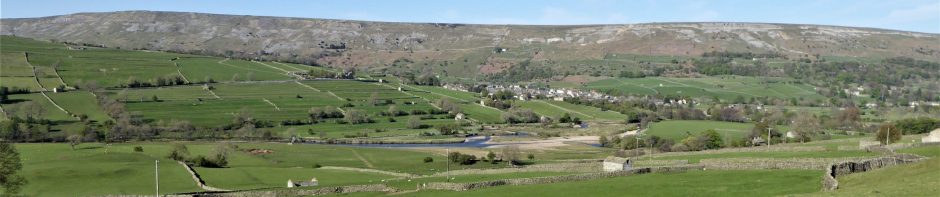
Header photograph shows a view across the River Swale to Reeth village, with medieval lynchets to the left and Fremington Edge forming the far horizon.
-
-
Receive our news - To receive alerts to your inbox every time any news is posted on our Home Page, simply enter your email address in the box below and click the Submit button. You won't be inundated and we won't share your email address with anyone.
-
-
You can also follow our social media posts. Just click on the icons below:
-


-
Copyright ©2009-2026 new-swaag.org. All rights reserved. Reproduction of SWAAG web-site content is permitted subject to inclusion of a visible acknowledgement to the Swaledale and Arkengarthdale Archaeology Group and to the individual content creator, where named.