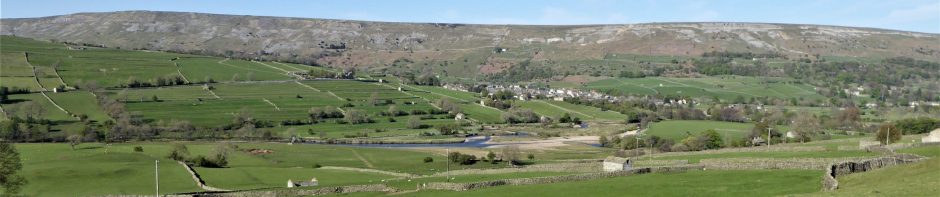

The circumstances of the 19th-century discovery at Fremington of a hoard of 75 decorative metal embellishments for Roman Army horse harnesses, remains frustratingly obscure.
Today, three of the objects are part of the permanent display at the Yorkshire Museum in York, Roman Section, case 13. Of the remainder, all but seven are in the museum’s stores, and the other seven are on display at the British Museum in London, upper floor, Gallery 49, the Weston Gallery (Roman Britain), display case number eight.
Information and photographs can be seen in the SWAAG database Archaeological Finds category PDF, scroll to record no. 592. However, since this record was made, in 2012, more of the source information has become available online, and so the following will be a helpful companion.
No-one knows exactly when or where the objects were found. They were listed in the Yorkshire Museum’s first catalogue, published in 1852, but according to one researcher might have been donated at least 19 years earlier, and were possibly the product of two donations at two different times, and possibly from two different find spots. See the Yorkshire Museum 1852 catalogue entry here: A Descriptive Account of the Antiquities in the Grounds and in the Museum of … – Charles Wellbeloved, Yorkshire Philosophical Society – Google Books, page 59. In this catalogue, the find spot was described as “on Fremington Hagg”, which presumably means at or on the land of Hagg Farm.
According to British Museum records, the seven objects in its possession were donated by its own keeper of British and Medieval Antiquities, Augustus Wollaston Franks (employed 1851-1896). He is known to have used his personal wealth to purchase objects for the museum as well as building his own vast private collection, which was eventually donated to the museum. It isn’t known how he came to acquire the Fremington objects.
In the early 1970s, doubts emerged over the connection between the separate holdings of the two museums, so technicians tested selected objects from each and compared them. Any doubts were allayed when they found that the metal compositions were so similar as to suggest “not only were they cast in the same workshop, but also from the same crucible of metal.” An illustrated report on the findings of this exercise can be read in an article, Roman Horse-trappings from Fremington Hagg, Reeth, Yorkshire, N.R., by P T Craddock, Janet Lang, and K S Painter, in British Museum Quarterly, vol. 37, summer 1973. It is accessible via JSTOR at Roman Horse-Trappings from Fremington Hagg, Reeth, Yorkshire, N.R. on JSTOR.
Quite recently, the British Museum has published, in its online catalogue, images and information about the seven objects (see link below). Interestingly, it identifies all the items as part of a “Reeth Hoard”, five of them specified as found at Fremington Hagg and the other two as found at Reeth. The discrepancy raises the possibility that there were indeed two different find spots, and if so, they were probably discovered at two different times.
The British Museum collection includes one object that isn’t a horse harness fitting. It’s a sword-scabbard fitting called a chape and can be seen in the online monochrome photograph of the whole collection. A less-well preserved chape is also in the Yorkshire Museum collection, as are several other small metallic decorative items that might not be horse harness fittings.
The relatively recent entry in the British Museum online catalogue can be seen here: Collection search | British Museum
The hoard is also listed by Historic England at Heritage Gateway – Results
Above article by Will Swales