A comprehensive record of tithes, and of the people who paid them and received them, was created throughout the nation in the 1830s and 40s as part of the statutory conversion of tithes from a medieval tax, payable as a tenth of every farm’s produce to its local church, to an annual rent payable in money.
Tithes had been created as a way of paying local clergymen. English medieval churches were generally built and funded by the manorial lord, who became the patron and owner of the advowson, the name given to the right to appoint a rector, a clergyman to oversee the church and parish. Rectors gained their income from the tithes of parishioners and sometimes also from church land in the parish, called glebe land. But rectors often did no work in the parish, instead appointing a vicar who would do the work ‘vicariously’ (in the place of the rector), for which vicars took a lesser share of the tithes.
Advowsons could be sold or gifted. Manor lords sometimes gifted the advowson of a parish church to a monastery, which effectively became the self-appointed rector. In such cases, the monastery took the greater share of the tithes and appointed a vicar to do the work in return for the lesser share. After the dissolution of the monasteries in the 16th century, their advowsons were confiscated by the crown and then sold to wealthy individuals, who continued to collect the rector’s share or ‘benefice’ of the tithes and were termed ‘impropriate rectors’ or ‘impropriators.’
By the mid-19th century, through local agreements, many tithes had already been converted to money rents, still payable to the vicar and the impropriator. However, these local arrangements varied greatly, so to tidy it all up, the government passed the Tithe Commutation Act 1836. It ordered the valuation of all tithable land and the apportionment of uniformly calculated and applied money rents in lieu of farm produce or any other arrangement previously made.
These valuations were achieved by a massive survey of the nation that mapped and numbered every plot of land that was subject to tithes. And for each plot, however small, a record was made, called a Tithe Apportionment, identifying each plot by its plot number on the map, naming every landowner and occupier, describing the plot’s function or method of cultivation, its identifying name, its measurement in acres, roods and perches, stating the rent in lieu of tithes to be payable in pounds, shillings, and pence, and naming to whom it was payable.
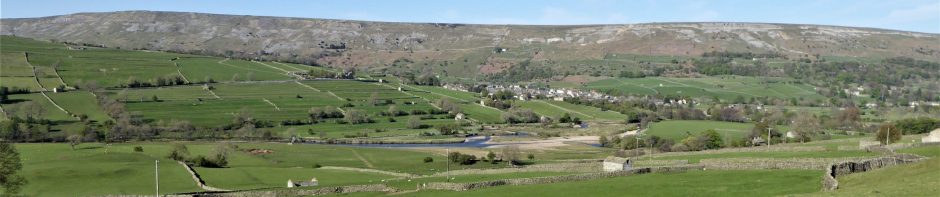
The complete set of records for the townships of Arkengarthdale, Grinton, Reeth, Melbecks, and Muker cover 6,703 plots of land, all recorded in lists and maps made between 1839 and 1845. It’s a treasure trove for genealogists, especially when consulted in conjunction with the first census to list the names of all household occupiers, which was conducted in 1841. Click the heading below to open a small table showing for the five townships the dates when the apportionment records were completed, the dates when the related maps were made and identifying the recipients of the new rents.
Tithe apportionment and plan summaries
| Township | Map dated | Apportionment completed | Vicar | Impropriator |
| Arkengathdale (called Arkendale) | 1841 | 31 Dec 1841 | [no beneficiary] | Sir John Lowther of Swillington, Baronet. |
| Grinton | 1841 | 30 Sept 1844 | Vicar of Grinton | Frances Jane Tomlin of Richmond, Widow, and Thomas Bradley of Richmond, Gentleman. |
| Melbecks | 1843 | 9 Sept 1844 | [ditto] | [ditto] |
| Muker | 1841 | 8 Sept 1845 | [ditto] | [ditto] |
| Reeth | 1839 | 30 Sept 1844 | [ditto] | [ditto] |
By Will Swales, 1 November 2024.