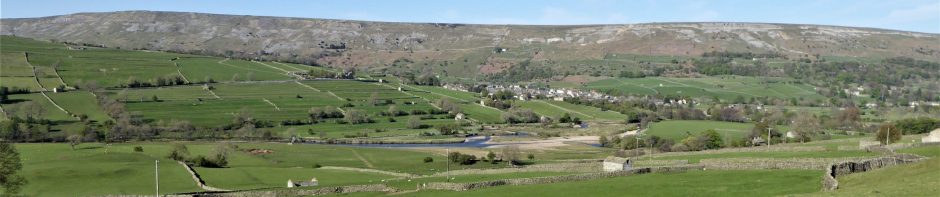


From the early 1100s to the Dissolution of the Monasteries in the mid-1500s, large amounts of land in upper Swaledale were held by two of Yorkshire’s great religious houses.
Bridlington Priory held vast estates all over Yorkshire. In Swaledale its land was in Grinton, Harkerside and Whitaside. Rievaulx Abbey’s land in Swaledale was in what is now the civil parish of Muker, with estates located from Oxnop in the east to Birkdale in the west.
Accounts of these landholdings were recorded by monks, in Latin, and preserved in each monastery’s charter books, otherwise known as chartularies or cartularies. These books have been transcribed, translated into English, published in abridged form, and can be seen online here:
Abstracts of the charters and other documents contained in the chartulary of the priory of Bridlington in the East Riding of the county of York : Lancaster, W. T. (William Thomas) : Free Download, Borrow, and Streaming : Internet Archive
and
Cartularium Abbathiae de Rievalle : Surtees Society, Durham, Eng : Free Download, Borrow, and Streaming : Internet Archive
A helpful study aid
To assist researchers of the history of Swaledale, SWAAG member Alan Mills has studied these published versions and created a helpful reference to the Swaledale lands mentioned within them, giving page references so that they are easy to find in the online publications.
Alan’s study aid also covers two other useful sources:
– In the case of Rievaulx, there were records of the abbey’s landholdings in a set of government accounts, written in English at the time of the dissolution. This has been transcribed and published but the publication is not currently available online.
– There is also a reference to Scots raiders in Swaledale in the year 1315 in a published translation of the Chronicle of the Lanercost, written at Lanercost Priory, near Brampton in Cumbria. It can be viewed here: The Chronicle of Lanercost, 1272-1346 : Translated, with notes : Maxwell, Herbert, Sir : Free Download, Borrow, and Streaming : Internet Archive.
Alan’s commentary and list of references in all four of the above publications can be seen here: Extracts from the chartularies of Priories and Abbeys holding land in Medieval Swaledale