
Burial mounds, generally called barrows although often marked on old maps by the Latin term tumuli, were constructed differently from round-cairn burial monuments, are larger in area and height, and are more likely, but not always, to be found at lower altitudes.
They are frequently the subject of uncertain interpretation, and the 12 potential barrow sites so-far-identified in Swaledale and one in Arkengarthdale, all recorded in the Yorkshire Dales National Park Authority Historic Environment Record (YDNPA HER), are no exception. One of the Swaledale sites is thought most likely to be a modern spoil heap, and it has been suggested that several of the others might be either of two types of glacial features called drumlins and kames, both of which were composed of sand and gravel deposits.
Sites thought by some to be the most likely burial mounds are subject to further questions about their antiquity. Traditionally, most burial mounds in the Yorkshire Dales have been designated as round barrows (being either round or oval-shaped), a type belonging to the Bronze Age, and constructed mainly in the period c. 2000 BC to c. 1500 BC.[1] However, some archaeologists currently studying the Yorkshire Dales are making a case that some sites are, or were originally, elongated enough to be better designated as long barrows, belonging to the earlier Neolithic or New Stone Age and constructed from as early as c. 3800 BC.
Sites recorded on the SWAAG database
SWAAG president Tim Laurie has voiced some scepticism about the validity of several of the possible burial mounds in the two dales, which probably explains why on the SWAAG database he entered only one of the 12 potential sites in Swaledale plus the one in Arkengarthdale. His thoughts on these two can be seen in the Category PDF Burial mounds and cairns (scroll to the first and seventh entries, record nos. 114 and 279).
Record 114 – SD 915 976 – is about a site east of Muker village and south of Gun Ing Lane. It includes a note on Tim Laurie’s doubts about this and other sites in Swaledale. This mound site is also recorded at ‘Possible Bronze Age barrow south of Gun Ing Lane’, YDNPA HER Heritage Gateway – Results.
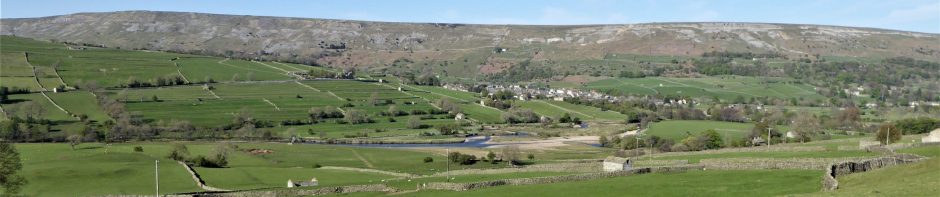
Record 279 – NZ 005 022 – is about a site at Langthwaite, Arkengarthdale (photo at the head of this page). It is also recorded at ‘Probable cairn or barrow at Langthwaite,’ Arkengarthdale, YDNPA HER Heritage Gateway – Results.
Record no. 466 – SD 906 973 – is a third barrow entry in the SWAAG database Category PDF ‘Burial mounds and cairns.’ It describes a site near Three Loaning End, Muker Side, south-east of Muker village. It is considered doubtful, as indicated by its record title at the YDNPA HER database – ‘Probable modern spoil heap’ Heritage Gateway – Results.
There are 10 other barrow sites described in the SWAAG database Category PDF Burial mounds and cairns all of them located beyond Swaledale and Arkengarthdale; the remaining 21 records in the Category describe round-cairn sites, for which see this web site’s page Round Cairns.
Two sites listed by Historic England as scheduled ancient monuments
Swale Hall – SE 039 985 – A large round mound, measuring 30m x 26m x 3m high, located to the west of Swale Hall in Harkerside, on a terrace just above the river, a characteristic shared with others of the Swaledale mounds. It is one of the most common sub-types of round barrow, called a bowl barrow, because it is shaped like an upturned round bowl. See the official listing here: Bowl barrow at Swale Hall, Grinton – 1012599 | Historic England. It is also recorded here: ‘Bronze Age Bowl Barrow surviving as an earthwork,’ YDNPA HER Heritage Gateway – Results.
Maiden Castle east – SE 023 981 – A more-oval-shaped mound, measuring 35m x 28m x 1.7m high, located at the eastern end of an ancient avenue of stones leading to the prehistoric defended settlement of Maiden Castle. The barrow is included in the ancient monument listing for Maiden Castle. See the official listing here: Maiden Castle prehistoric defended settlement and adjacent round barrow, Grinton – 1012609 | Historic England. It is also recorded here: ‘Almost certainly a Bronze Age barrow,’ YDNPA HER Heritage Gateway – Results.
This barrow and its near neighbour, described below as Maiden Castle west barrow, were mutilated by the 19th-century barrow-digger Canon William Greenwell (1820-1918), of County Durham. He was the leading 19th-century expert on ancient barrows. He authored the first comprehensive work on the subject, British Barrows: A Record of the Examination of Sepulchral Mounds in Various Parts of England (Oxford, 1877), which ran to a mammoth 776 pages. It was re-published by Cambridge University Press in 2015 and is currently available. Canon Greenwell excavated nearly 300 burial mounds, mainly in the north of England, especially in the Wolds of the East Riding of Yorkshire.
His book didn’t include any reference to his digs in the barrows on Harkerside Moor, an omission explained by a report published at the time of the digs in the Yorkshire Post and Leeds Intelligencer newspaper of 22 June 1867, which read as follows:
“Richmond – tumuli digging on the Swaledale Moors – The distinguished archaeologist, the Rev. Canon Greenwell, of Durham, has, during the past week, been examining the ancient burial mounds in this valley for historic purposes. He was accompanied by Mr Wood FGS, of Richmond. These gentlemen carefully investigated the remains of barrows on the wild moors of Harkerside and found many traces of a people which existed perhaps 3,000 years ago. The interesting remains, ‘Maiden Castle’ and the moats and mounds, were carefully examined, and they promise to be a rich field for exploration. Through the kindness of Mr G A Robinson, of Reeth, permission was given to open the tumuli and that gentleman placed a very effective staff of miners at the disposal of the party. The result of the day’s work was not successful, for though many graves of the usual ancient British type were examined, not a single bone or fragment of man’s work was found. These gentlemen intend to pay the same district a second visit, to more carefully examine the traces which Mr Greenwell’s explorations on the Yorkshire Wolds have made objects of great interest to all lovers of archaeology. It may not be out of place to state that any person in the district who may have found, or even heard of any remains of ‘ancient man,’ such as spears, flint or stone implements, vases or any traces of pottery, as well as human skeletons, would advance this important investigation materially by making the result of their discoveries known to any of the gentlemen interested, to whom, for their zeal in the advancement of science, the public is much indebted.”
There are no known records of Canon Greenwell returning to Swaledale for the intended second visit.

Eight further sites recorded in the Yorkshire Dales National Park Authority Historic Environment Record (YDNPA HER)
Maiden Castle west – SE 019 979 – An elongated mound, measuring 25m x 13m x 1.7m high and described in the YDNPA HER as a neolithic long barrow. It is located on a natural terrace about 200m west of Maiden Castle but not part of the castle’s listing as a scheduled ancient monument. It is partially mutilated, having received the attention of the barrow digger Canon William Greenwell (see above). A modern currock of stones, or cairn, has been erected at the top of the mound. The site is recorded here: ‘Maiden Castle Neolithic long barrow,’ YDNPA HER Heritage Gateway – Results.
For photographs and site plans showing the position of both the east and west barrows and adjacent round cairns near Maiden Castle, see the SWAAG database PDF Category SWAAG sites (scroll to the second entry, record no. 2). For a geophysics survey of Maiden Castle and its neighbouring barrows see a report by Durham University Archaeological Services supported by SWAAG members – Report (2011) on geophysics surveys of two sites, the first being the survey of the Maiden Castle sites.

Slacks Close, east of Browna Gill – SE 012 983 – In a roadside field next to Slacks Cow House, Harkerside, this site has been otherwise identified by Tim Laurie as located 700m below [downstream of] Scabba Wath [locally Whita] Bridge. It is an elongated mound, measuring 25m x 18m x 2m high and is recorded here: ‘Possible Neolithic Long Barrow, east of Browna Gill,’ YDNPA HER Heritage Gateway – Results.

Sand Beds – SD 995 982 – An elongated mound, measuring 25m x 18m x 1.5m high and described in the YDNPA HER as a neolithic long barrow. There is evidence of antiquarian excavation on its summit. It is recorded here: ‘Sandbeds neolithic long barrow,’ YDNPA HER Heritage Gateway – Results. Confusingly, it is also recorded separately and differently on the same database as ‘Prehistoric round barrow,’ YDNPA HER Heritage Gateway – Results.
Haverdell Farm – SD 973 971 – This location, in Crackpotside, near to Isles Bridge, is sometimes erroneously called Haverdale House Farm. Further confusion comes from some records of the position of the mound. It lies in a field next to Dubbing Garth Lane, which runs alongside two houses. The site is west of the old parsonage and east of Haverdell Farmhouse. The mound is oval shaped, measuring 18m x 15m x 1.5m high, and has been described as a Bronze Age barrow. It is recorded here: ‘Possible burial mound, Haverdell Farm,’ YDNPA HER Heritage Gateway – Results.
There is a compelling historical record about this barrow being dug in 1847 and revealing seven skeletons. The account appeared in Thomas Whellan’s History and Topography of the City of York and the North Riding of Yorkshire, vol. 2 of 2, published in Beverley, Yorkshire, in 1859. It relates to the building of the parsonage, which housed the curate in charge of the new parish of Melbecks. The location of the parsonage was unusual because most of the parish of Melbecks, including a recently built church in Feetham, lay across Isles Bridge, on the other side of the river. The account recalled:
“The township of Melbecks and part of those of Grinton and Reeth were formed into an ecclesiastical district in 1841. The church (Holy Trinity) was erected at Feetham about the same time … There is a neat parsonage house, erected by the ecclesiastical commissioners in 1846 at a cost of £900. Whilst digging a mound in a field at the rear of this house for gravel for the garden walks of the parsonage in 1847, the remains of seven human bodies were discovered with their heads lying towards the west. The teeth in one of the skulls were quite perfect, and the buckle of a sword belt and other small matters were found in the mound with the skeletons. These bodies are supposed to have belonged to some of the followers of the Young Pretender in 1745 as the inhabitants have a tradition that a skirmish between the Scots and the dalesmen took place in this neighbourhood.”

Low Row Pasture – SD 967 981 – This roughly circular mound, measuring 14m in diameter, with a height described only as ‘low’ and ‘shallow,’ is located on Barf Side, being low moorland of low Row Pasture. It has been described as a cairn of grey sandstone rocks covered by turf, and partly reduced by quarrying for stone. It is recorded here: ‘Possible late-neolithic barrow, Low Row Pasture,’ YDNPA HER Heritage Gateway – Results.
Low Oxnop – SD 929 975 – This is a roughly circular, grass-covered mound near Low Oxnop farmhouse. It measures about 8-9m in diameter x about 0.5m high, was identified by YDNPA staff, and is said to be a ‘late-prehistoric round barrow.’ It is recorded here: YDNPA HER Heritage Gateway – Results.
Tute Hill, Keld – NY 893 011 – This large grass-covered, round burial mound is located on Tute Hill at the edge of Keld village, upper Swaledale. It was recorded by Yvonne Luke as a late-prehistoric tumulus or barrow, measuring 15m diameter x 2m high, and cut into by a barn and hollow way. It is recorded here: ‘Tute Hill tumulus,’ YDNPA HER Heritage Gateway – Results.
Potential neolithic long barrows
A leader in the discussion about more barrow sites in the Yorkshire Dales being re-designated as older, neolithic long barrows (see above introduction, paragraph three) is Yvonne Luke, whose investigations are explained in detail in her article ‘Out of the shadows: an emerging Neolithic in the Yorkshire Dales,’ in New Light on the Neolithic of Northern England, eds. Gill Hey and Paul Frodsham (Oxford 2021).
Among the sites described, she makes a case for neolithic barrows for three of the Swaledale sites described above, at Maiden Castle west, Slacks Close/east of Browna Gill, and Sand Beds, and then for one other, which is not presently found on any database. It is the latest of the 12 potential barrow sites so-far identified in Swaledale:
Healaugh – SE 015 989 – This site, between the west side of Healaugh village and Barney Beck and just north of the road to Kearton, is described as an earth mound, measuring 35m x 15m x 1m high, on a river terrace with a shallow natural bank running lengthways beneath, and as probably a neolithic long barrow.
This article by Will Swales, March 2024.
[1] Historic England – Prehistoric Barrows and Burial Mounds – Introductions to Heritage Assets.