Records in this genealogy section of the website use the measures of land and money that were universally applied in England at the time of their creation, now known as Imperial measures, and sometimes little-understood by those of an age not to have been taught them in school.
Land – The area of land was measured in acres, roods, and perches. The smallest of these, the perch, was immediately confusing because it was a term used to describe a straight-line distance as well as an area. A perch in area was nominally a square measuring one perch by one perch. This measure of distance was also called a rod or a pole, because it was measured in the field using a very long wooden rod or pole, which was 16.5 feet (16ft 6 inches) long, or by the modern measure 5.03 metres. Therefore, a perch in area was the modern equivalent of 25.29 square metres. An inch was one twelfth of a foot, or the equivalent of 2.54 centimetres.
There were 40 perches by area in a rood, which today is 1,012 square metres. There were four roods in an acre, which today is 4,047 square metres. Land is now more usually measured in the metric unit of a hectare (10,000 square metres or 2.47 acres).
The tithe plans in this section of the website are at a scale of six chains to an inch. A chain was measured using a surveyor’s chain, which was the length of four surveyor’s poles, rods, or perches. It was and still is the length of a cricket pitch, which by the modern measure is 20.1 metres. There were 10 chains in a furlong, and eight furlongs in a mile.
Money – The amounts of money used in these old records, were measured in pounds, shillings, and pence, the system that was formally replaced by decimal currency in 1971. In that year, the value of a pound did not change, but the value of a penny increased so that the number of pennies in a pound changed from 240 to 100. Also, the denomination of a shilling (worth 12 old pence or one-twentieth of a pound) was abolished.
The imperial symbols for pounds shillings and pence were £ s d. At decimalisation, the symbol s became redundant and the penny-symbol, d, from the Latin denarius, was changed to p.
-
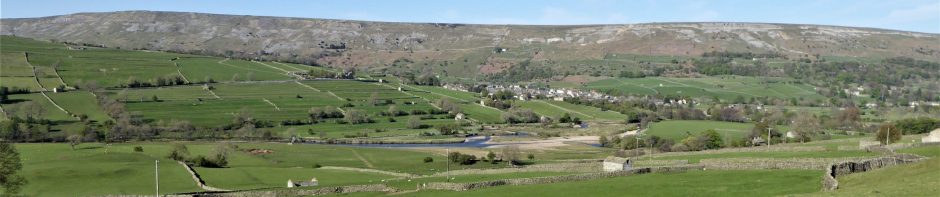
Header photograph shows a view across the River Swale to Reeth village, with medieval lynchets to the left and Fremington Edge forming the far horizon.
-
-
Receive our news - To receive alerts to your inbox every time any news is posted on our Home Page, simply enter your email address in the box below and click the Submit button. You won't be inundated and we won't share your email address with anyone.
-
-
You can also follow our social media posts. Just click on the icons below:
-


-
Copyright ©2009-2026 new-swaag.org. All rights reserved. Reproduction of SWAAG web-site content is permitted subject to inclusion of a visible acknowledgement to the Swaledale and Arkengarthdale Archaeology Group and to the individual content creator, where named.